Missed. Untracked. Uncounted.
Patients with persistent fluoroquinolone-associated disability (FQAD) are often unrecognised, undocumented and untracked. That leaves people without coordinated care, and health systems without reliable data on how many are affected.
Johanna Ihli, BSN — former ER/trauma/critical care RN · independent researcher, DIMD Initiative
Recognised by Regulators. Not Yet Counted.
A decade after the FDA (2016) and the European Medicines Agency (2018–19) warned of disabling, long-lasting and potentially permanent effects, no health system systematically identifies, registers or longitudinally follows these patients.
*Conservative lower bound from published US prescribing and ECDC consumption data, 1987–2025. Counts courses, not people. Excludes hospital and military use.
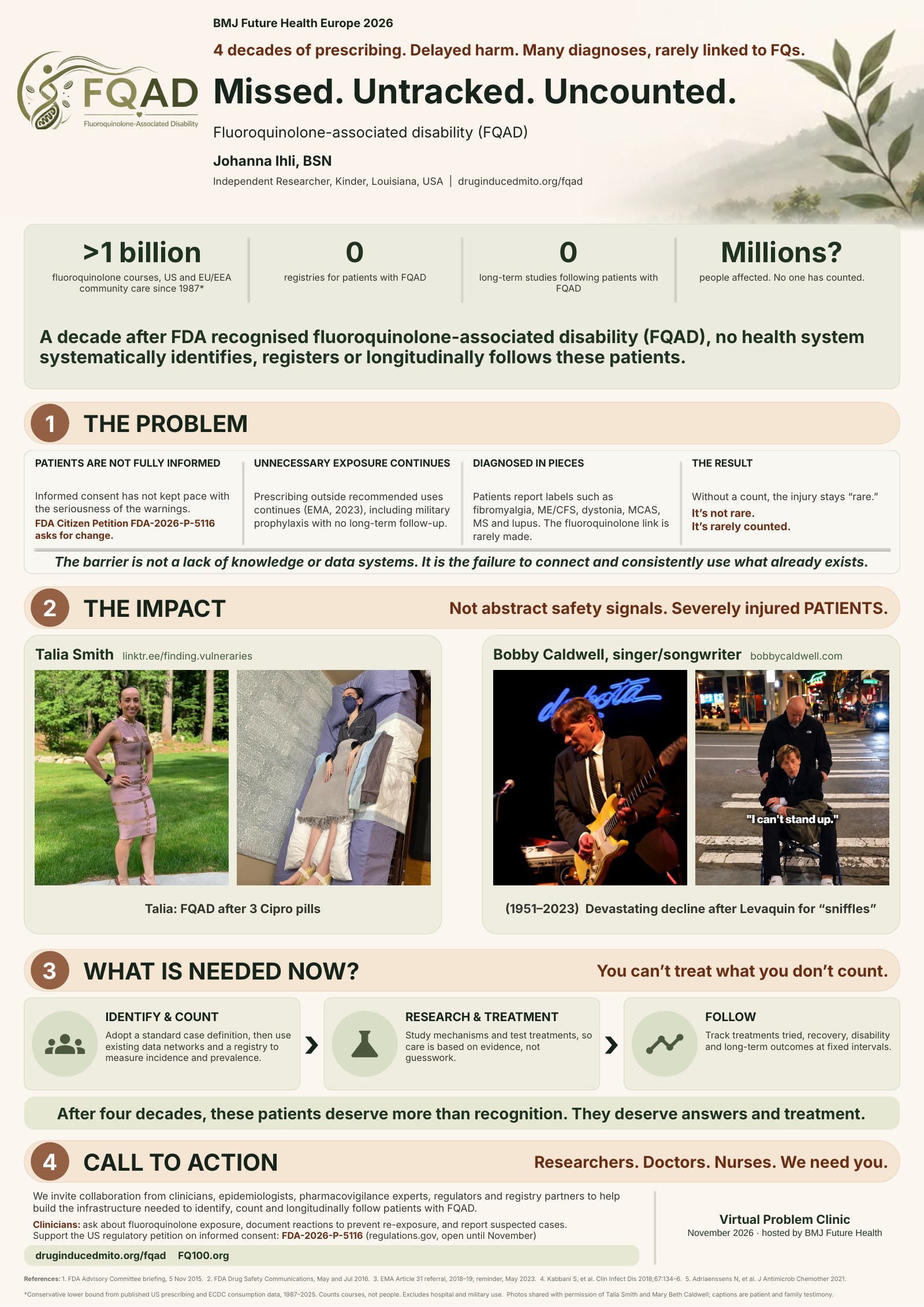
Tap the poster to open the full-resolution PDF.
BMJ Future Health Europe 2026
This problem statement was accepted through BMJ Future Health's Call for Problems, which invites patients, clinicians and others to bring real-world healthcare problems to people who can help solve them.
- ePoster and video presentation at BMJ Future Health Europe, 29–30 October 2026, The Brewery, London.
- Abstract to be published in BMJ Innovations, November 2026. Pending
- Virtual Problem Clinic hosted by BMJ Future Health, November 2026. Date TBC
Three Gaps, One Pattern
FQAD can affect tendons, muscles, joints, nerves, cognition and mental health, and symptoms may begin or worsen after the drug is stopped. Care is organised by specialty, so patients are often evaluated one organ system at a time. Patients report labels such as fibromyalgia, ME/CFS and dystonia. The fluoroquinolone link is rarely made.
There is no registry, standard case definition or long-term follow-up for persistent FQAD. Reactions are not consistently documented, so patients can be re-exposed because an earlier reaction was never recorded.
Spontaneous reporting systems capture only a fraction of adverse reactions. Without a denominator, the injury stays labelled "rare." It's not rare. It's rarely counted.
The barrier is not a lack of knowledge or data systems. It is the failure to connect and consistently use what already exists.
You Can't Treat What You Don't Count
Identify & Count
Adopt a standard case definition, then use existing data networks and a registry to measure incidence and prevalence.
Research & Treatment
Study mechanisms and test treatments, so care is based on evidence, not guesswork.
Follow
Track treatments tried, recovery, disability and long-term outcomes at fixed intervals.
What exists today
The DIMD Registry is an early, de-identified patient-reporting initiative. It gives patients a place to be counted now, but it is not a clinical or research-grade registry.
What needs to be built
A research-grade registry with an institutional home: a standard case definition, clinical data and patient-reported outcomes, and longitudinal follow-up at fixed intervals. This is the infrastructure we are looking for partners to help build.
November 2026
Hosted by BMJ Future Health
A virtual Problem Clinic webinar on the FQAD surveillance gap will follow the conference in November 2026, with other speakers sharing lived experience of the healthcare system as patients and carers.
BMJ Innovations
The full abstract, including the proposed care pathway and references, will be published in BMJ Innovations in November 2026. A link will be added here once it is published.
Researchers. Doctors. Nurses. We Need You.
We invite collaboration to help build the infrastructure needed to identify, count and longitudinally follow patients with FQAD.
- An academic or institutional home for a research-grade registry
- Methods advice on case definitions, study design and outcome measures
- Access to existing data networks to estimate incidence and prevalence
- Introductions to people who can fund or host a pilot
Clinicians: ask about fluoroquinolone exposure, document reactions to prevent re-exposure, and report suspected cases (MedWatch in the US; in Europe, your national medicines regulator, which feeds EudraVigilance; the Yellow Card scheme in the UK). In the US, code suspected reactions with the fluoroquinolone-specific ICD-10-CM adverse-effect codes, so they can be counted and followed.